Monday, 26 March 2012

LUCIEN FREUD AT NATIONAL PORTRAIT GALLERY

NATIONAL PORTRAIT GALLERY - LUCIEN FREUD PORTRAITS, to 27 May 2012

LUCIEN FREUD - 1922-2011

Went last Thursday pm and was unpleasantly surprised at the huge crush of people and, once again, nowhere to sit except right at the far end of the several rooms/galleries.  You need at least an hour and a half to look at the works, preferably more.

I know Freud's work quite well but the exhibition confirmed my feeling that his early work has brilliance and colour, while the older work is gloomy, grey and depressing. 

I liked the drawing of Christian Berard, in black and white conte crayon, charming and a pleasure to study.  

Conte pastel of Christian Berard 


Also I liked the Auerbach head and the famous John Minton head of 1952. Apparently Minton commissioned Freud to paint this portrait.
I wonder if Freud had a problem with the widespread interest and publicity surrounding Pop Art in the 1950s and 1960s, in America and the UK?  I am thinking of Roy Lichtenstein's work, for instance.  He must have found such a movement quite difficult to ignore but I do not know of any of his work that shows an acknowledgement of Pop Art.  Instead the earlier, lightly toned portraits of the 1940s and early 1950s changed to those which are much bleaker and even more sombre in colour and tone.


JOHN DEAKIN
I noticed a head, of John Deakin, dated 1963-4 which, to me, suggested it was painted with affection, maybe?  Deaken was a photographer, for more about him see this information
Walker Museum exhibition on John Deakin
and look at Wikipedia too (could not get a link to work, sorry)
 http://en.wikipedia.org/wiki/John_Deakin  

Deakin died in 1972, and the photo on the Wikipedia page of him shows remarkable similarity to Freud's portrait.  Otherwise the heads and figures seem lacking in warmth, as if Freud really distanced himself from these people, some of them friends and family, and regarded them as so many objects.  However, there is one painting, of a red-haired man sitting in a chair and this stands out because the man is almost smiling (1962-63).  The only smile. Although another painting is called Woman Smiling, 1958-9, I could not see a smile here.


I mused on the idea that as we are so used to looking at famous faces that is why we love to check out the famous faces in this show?  Perhaps that is why Freud is so popular, and of course we all know what Freud looked like, from his many self-portraits and photographs, and we think that if we can place all the other faces and bodies, we are one of the 'in' crowd.  The 'in' crowd can comprehend and appreciate the works that sell for so much, and even if we really believe the images are ugly, depressing, degrading and voyeuristic, we are somehow hanging on to the celebrity status, clinging on anxiously, one of the Freud fan club.

The people attending the exhibition were entranced by these portraits, studying them carefully, on the whole.  Maybe the reason they are so popular is because we live in an age of the celebrity, even more so than in past decades?  Maybe we walk round exhibitions such as this one trying to put a name to a face, to put a story to a life lived in public eye, such as Martin Gayford in his blue scarf?

The colours Freud used seemed to tend towards grey/blue.  There is a large painting of the head and bosom of a Pregnant Girl, 1960-61, with lots of blue shadowy shapes on her nude body and also there is blue round the mouths of many heads, notable head of A Woman Painter, 1957and Head of a Child, 1954.  This blue can be seen very obviously in the portrait of HM The Queen, which has a distinct blue round the top and bottom lips, although you cannot check my observation as this painting is not in the exhibition.

Yes, I made a note there, "How dreary can you get?" when looking at the Painter and Model picture, where the woman on the left stands on oil paint tubes.  It seems like everybody is really pissed off at having to sit for him (for interminable hours) and the results are really immobile and inanimate, even the plants and animals are static.

Freud was lucky in that he was a success in his life time - unlike Watteau whose painting he used as a source.  The flesh he captures is the grey, cool flesh of the Brit, it seems as if it would be clammy and cold to the touch, no warm olive or brown skins here.


CHILDREN AND DOGS

Not much joy in this National Portrait Gallery show, then.  The children and pet dogs painted seemed similarly cowed into submission;  did he ever try and get an animated expression, such as did Hogarth, for instance?  I wonder if his fame had a deadening effect on the sitter?

My opinion after thinking about is for a few days, is that Freud got into a pleasant rut and liked the cash when it started rolling in.  The more grotesque the model, the more money he could make.  Where was the joy in painting, the fun?  I saw no evidence of the delight that an artist feels when the struggle works.  Even the studios seem sorry for themselves.  It seems like he hated the studio, the dingy walls, the crappy old chairs and sofas, the messy floor.  On the other hand, the rooftops and walls of the out-of-the-window view works well.

There was no impression that Frued loved the work he dedicated himself to, so maybe it was just a very lucrative 'hobby' ?  Obviously he couldn't fund his gambling addiction in an easier way.  And the adulation must have been addictive too. And the girls.

Some of the last works, right at the end, have strange accumulations of pigment, almost three-dimensional, so thick, especially on the faces, as if to see how much oddity he could get away with and still sell.

There is a lot of anxiety in this exhibition, the anxiety of the model, fearing that maybe the artist will reject him or her, or portray them in a crude, cruel new slant which will keep the public buying but will keep them for every in the public eye as an ugly icon.


ETCHINGS BY FREUD
These are lovely etchings, which I shall return to examine again, as they are outside the main exhibition so you do not have to buy a ticket to go and look at them

Tuesday, 20 March 2012

'SNAP' SOUTH LONDON WOMEN ARTISTS EXHIBITION

BANKSIDE EXHIBITION FOR SOUTH LONDON WOMEN ARTISTS GROUP

The next exhibition of the SLWA will be held for one week from 30 April to 8 May.

My painting will be on display at the  Bankside Gallery.  It is an oil painting on canvas, measuring H56 x W76 including frame.

Edna Runs London Marathon

The painting was inspired by my visit to the 2011 London Marathon, held last April.

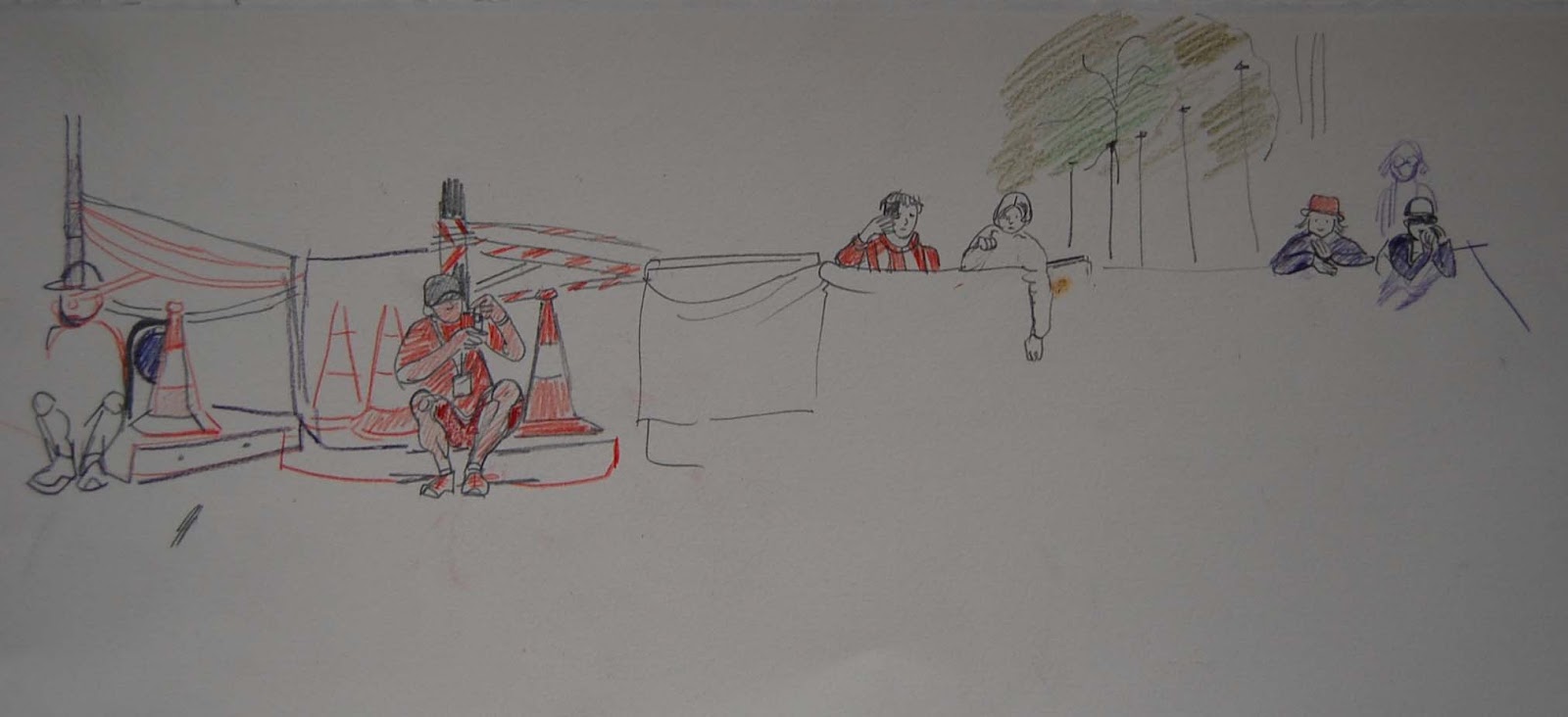
I was standing near to Westminster Tube Station and was able to watch the elite runners pass, with the spectators and marshalls making an exciting backdrop to the runners.

In my painting I have featured the Kenyan runner, Edna Kiplagat.  My source material included pencil sketches and photographs.  As well, like most artists, I have a good visual memory so that comes into helpful effect.

You might notice the statue of Windston Churchill on the right, which at the time the statue was surrounded by protective mesh fences.

On the right you can see the huge figure of a teddy bear, with the word CORAM on a sash.
Here is a link to the CORAM charity web site:
CORAM, BETTER CHANCES FOR CHILDREN

Coram Bear at London Marathon 2011, oil painting


This bear was part of the support group for the runners who were raising spondorship money for the CORAM charity, and I thought it particularly attractive with its friendly smile.

Of course a lot of photographs were being taken by the crowds, as well as by the official photographers.  All kinds of positions were taken so as to get a good view, and it seemed that everybody was trying to get that perfect shot, though they did take time to clap and shout encouragement.

The Bankside Gallery is very near the Tate Modern Gallery, on the Thames Path, and is open every day from 11am to 6pm
BANKSIDE GALLERY SLWA EXHIBITION APRIL 30, 2012


Wednesday, 22 February 2012

THE MARIGOLD HOTEL - NEW FILM SET IN JAIPUR

THE BEST EXOTIC MARIGOLD HOTEL


We were luck enough to see this new film at a preview in Surrey last night.  


This is extremely enjoyable and I recommend it - in fact I might go and see it a second time!
Some of the dialogue is very funny indeed and of course the cast is one to die for - even the beginning of the film, set in England, is amusing and relevant to me, being somewhat 'over the hill' myself!


Very beautiful did India seem.  Top marks to the photographer and director and all the back-room people, it must have been very difficult to film in the streets, of what I presume is actually Jaipur.
IMDb website with more about the film


The colours and plants, the market stalls, the drummers, the marigolds themselves, all delightful.


I particularly liked the crumbling building that formed the hotel itself.  It makes me want to go to India, to that part, where I have not had a chance to go, as yet.  I have visited Goa, which seemed much more quiet and sedate.


Of course, one thing the film missed out was the smells, the heat, the problem with tummy upsets and the long boring waits for things, such as taxis that don't turn up on time.  But then, the real thing is always going to be more fun than a film.  What the film can give you, is a nice burst of colour and nostalgia at the turn of a switch (if you have the DVD of course).


I congratulate everybody concerned with this film, and wish it great success.


Holywood Reporter website about the film

Friday, 17 February 2012

THE MYSTERY OF APPEARANCE

HAUNCH OF VENISON - 103 NEW BOND STREET, LONDON

"TEN OF BRITAIN'S MOST IMPORTANT POST-WAR PAINTERS"

This was my first visit to this gallery, at the top end of Bond Street so not far from Oxford Circus or Bond Street tube stations.
I was intrigued to read a description of the exhibition, The Mystery of Appearance, which ends 18 February, from the gallery website.

THE MYSTERY OF APPEARANCE

The painters are well known to me, so I thought to see something familiar from previous gallery visits.  There were some things which are new to me, but the two big Hockneys I have seen before certainly.  Apparently only three of these ten artists are alive today.

The two painters who prefer to use very dense, textured oils have similar works on display, Leon Kossof and Frank Auerbach.   I don't like them.  There is an Auerbach with a title including the name  Gerda Boehm of 1971-73 which is aesthetically unpleasant.  One painting by Kossoff titled Seated Woman No 2 of 1959 reminded me of a very large cow turd which had been played about with - brown and nasty.
The Hockney painting of a young man reclining on a bed, The Room Tarzana, showed his ability to paint tufted rugs and venetian-blind slatted doors, but the figure has a strangely floating arm, rather oddly positioned buttocks and very tiny feet. 

A small female nude by Freud of 1956 seems to be mainly a view of her bottom, with very large feet which reminded me of feet painted by Francis Bacon. 

There is a large Bacon painting  (Pope 1) which is very familiar.

The Euan Uglow paintings did not seem so exciting in actuality, they seem to present themselves better in reproductions.  Maybe it is the very very pink paint in the large female nude study?

There is a small sketchy head by Michael Andrews which appeals, maybe because it is so very sketchy.  As a contrast there is a very large painting of Norwich Castle Keep, which is entitled Lord Mayor's Reception, Norwich.  This is apparently oil on canvas but seems to be oil on photograph, the black and white shows in large parts of the image.  I presume the photograph was transferred to the canvas and then he painted over it in parts.  Since I have just returned from looking at an exhibition in Norwich Castle Art Gallery, and walked through the keep, this was of interest and I felt that he had tackled a very difficult and boring subject with a certain amount of panache.
The Lord Mayor's Reception

However, to sum up, all these painters seemed to working without any lightness or humour, a lot of works are dour and gloomy, the paint looked as it it needed dusting,  I made a note in my little book that the artists were, from these representational painting, all very serious and po-faced.

There were three working drawings, squared up, by Patrick Caulfield, and I wonder at the decision to hang these, since they did not seem to stand up to hanging alongside finished work by him, of the usual bottles.  Very accurate-looking architectural drawings.

I was interested to see the black and white portrait photographs downstairs in the 'bookshop' which somehow seemed refreshingly honest and direct, unlike some of the paintings upstairs. They are by Bruce Bernard in the 1980s, of Bacon, Freud, Andrews and Auerbach.

Portrait of Francis Bacon 1984 by
Bruce Bernard


It was a relief to come out into the afternoon Bond Street glitz which in a way seemed so much more interesting and vibrant than these rather dejected works.

Tuesday, 17 January 2012

COLIN WIGGINS LECTURE: RESHAPING THE HUMAN FIGURE


RESHAPING THE HUMAN FIGURE: FROM ANTIQUITY TO MAPPLETHORPE

What an excellent lecture last week at Richmond on Thames as part of a series of lectures organized by the Richmond Art Society.

NATIONAL GALLERY

Colin Wiggins started by telling us that he is now Curator of Special Projects at the National Gallery.

Until recently he was Head of Education there.

He gave a one hour lecture with the above title, showing the continuity which is evident in  Western Europen art, depicting and sculpting the human figure from sources in Antiquity.

During this lecture he made many witty comments about modern practices in art; he said that the Leonard da Vince exhibition was a thorn in his side at present and that they had had 'turned David Hockey away this morning'.

He began by saying the central foundation stone of Western European art is 'us', in other words, the human figure. Of these works, the male figure is the most important.  He commenced by showing slides of sculpture of the male from ancient Greece.

Greek sculpture


He showed immediate links to figures sculpted by Michaelangelo,  and paintings by Velazquez and Lucien Freud.


This was demonstrated by a projected image of a Roman god next to a painting of the god Mars by Velazquez and a nude full-length portrait of Leigh Bowery by Lucien Freud.

Mars by Velazquez


Top part of Leigh Bowery portrait


Colin had many slides demonstrating his points, all of them interesting and relevant, particularly the works of the Italian Renaissance artists, such Raphael, who, he said, was not able to work from the nude female figure, it being impossible for a young man to have access to a nude female model.

Also we were asked to look at the Joshua Reynolds portrait of Sir BanastreTarleton, who fought in the American War of Independence.  Reynold had a directory of poses, from his time in Rome, and used a pose of Cincinnatus from antiquity for the Tarleton portrait.  Tarleton was apparently very 'thick' and Reynolds did not like him at all. He painted the figure in a battle scene with a cannon right behind his backside!

Cincinnatus sculpture

Sir Banastre Tarleton by Reynolds


The interest in ancient art was widespread in the USA too, from Victorian times, and he told of a mail order facility to order art from Europe, which resulted in a copy of the Venus de Milo being sent by railroad to the mid-west, where it was found to be without arms.  The purchasers sued the railroad company for the loss of her arms, and won their case!

Veus de Milo


There was a very amusing point made that maidens were painted and sculpted being very modest, and while nude, covered their 'private parts'.  This he demonstrated by showing us a sculpture of a Roman or Greek (not sure which) girl, then a nude by Renoir


Bather by Renoir
and then a still from the comedy Carry on Camping, when Barabara Windsor is bra-less and covering her bosom with her hands.
Still from Carry on Camping


Colin admires the 'passive and beautiful' male nudes of David Hockney and is looking forward to the exhibition later this year at the Royal Academy.

However he did not like the Gerhard Richter work at the London exhibition (now ended), and said he finds German contemporary art takes itself too seriously.
 TATE GALLERY, LONDON

My understanding is Colin suggested he likes humour in art and showed us a Johann Zoffany painting of the Tribuna in the Uffizi, Florence, where a collection of Milords are admiring the bottom of the Venus de Milo.

Johann Zoffany - more about him

I found a link to the Fitzwilliam Museum, Cambridge which shows Frank Auerbach standing beside a portrait etching of Colin Wiggins.
FITZWILLIAM MUSEUM, CAMBRIDGE 

COLIN WIGGINS - HE IS A 'NATIONAL (GALLERY) TREASURE'

TRAMPOLINES AT LONDON PREPARES, O2 ARENA

LONDON PREPARES SERIES AT 02 ARENA - GYMNASTICS IN 2012

We went along to North Greenwich last Friday morning, or rather, we attempted to get to North Greenwich but the Jubilee Line from London Bridge was delayed 'due to a signal failure' so nobody could get on the train.  

Much later we finally got to our destination, after going back to Waterloo.
It was very disappointing to find we could not bring in cameras, as I had lugged my heavy one with zoom lens.  However, I did these three sketches

Competitiors in the O2 Arena

Competitiors, who appear one at a time.

Audience included a lot of small children at O2 Arena


The Arena was almost full on one side, nearest the entrance, and no seats near the front. Nevertheless we could see quite well, as the Trampolines were in the centre of the arena, and the athletes were easy to follow, their jumps and twists quite spectacular.


GYMNASTS

It was very interesting because I have never seen top class gymnasts before and was not aware how spectacular their movements are.  Of course they compete one at a time, and not together as I have drawn them.  First was the men's competition and then the women's.  The Chinese men did very well.

More details can be found at BRITISH GYMNASTICS ORG.

VISA INTERNATIONAL GYMNASTICS - NORTH GREENWICH ARENA

Here is a quote from the Booklet with the above title: 

'At the 2011 Trampoline World Championships in Birmingham the top eight competitiors claimed places for their country at London 2012.  Those who missed qualifying at this event will battle for the five places up for grabs at this month's test event.  The FIG will aware a final three places at their discretion at a later date.'


Wednesday, 4 January 2012

LONDON MARATHON 2011 PAINTING

LONDON MARATHON 2011

I went along to the Marathon last April to get information and images for a painting.
I did some sketches and took photographs.
After all this time, I have started the new oil painting, which will be 50cm x 70cm/
Prepared some sketches and pencil drawings.
Here are some of them
A marshall takes some photos

I guess he is an official photographer

I stood near Churchill's statue

Two policemen near Westminster Tube

Westminster hidden by April trees

Two Japanese ladies
 Here are a couple of my sketch book pages

Spectators before the runners arrive

Runners are too fast to capture